The First World War is not an easy story to tell lightly. But across France, its legacy can still be visited, understood, and remembered through the places where Americans served, fought, and helped shape the course of history.
1914-1915 : Neutral, but increasingly involved
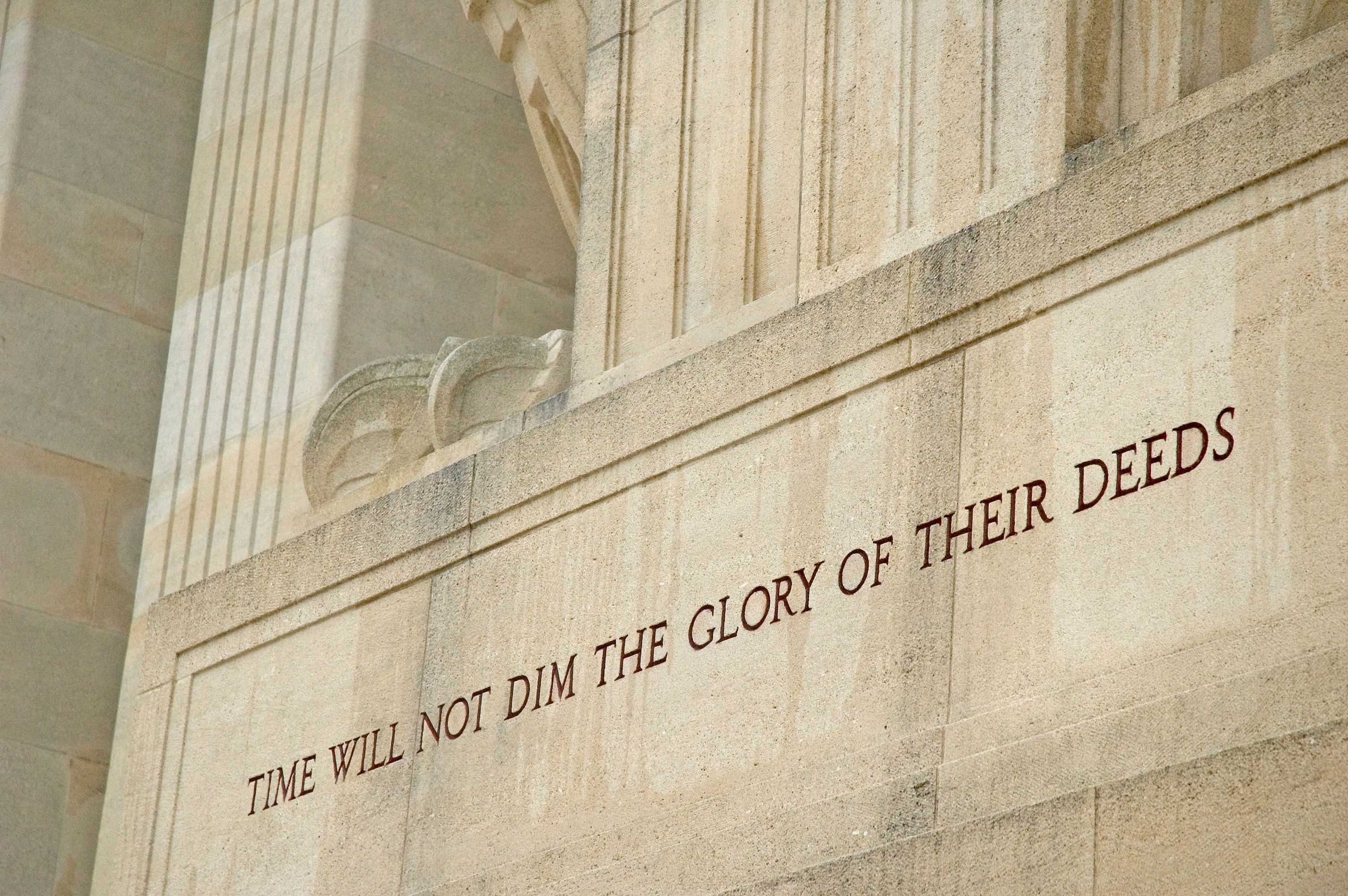
Inscription at the Aisne-Marne American Memorial: “Time will not dim the glory of their deeds.”
Photo: Legacay photoAdobe Stock
When the First World War erupted in Europe in 1914, the United States initially remained neutral. Yet thousands of Americans volunteered to support France and its allies long before their country officially entered the conflict. From ambulance drivers and pilots serving alongside French forces to the arrival of the American Expeditionary Force under General John J. Pershing, the war marked a defining chapter in the friendship between France and the United States.
Today, visitors can follow this history across France, from Belleau Wood and the Meuse-Argonne to Lafayette's grave in Paris, the Palace of Versailles, and the memorials and cemeteries that honor American service. The timeline below highlights key moments whose legacy can still be explored across France today.
1914 — Although the United States maintains its neutrality, American men and women volunteer to assist the wounded of France, Britain, and Belgium. Many serve as ambulance drivers, nurses, and relief workers on the front lines of the conflict.
April 15, 1915 — The American Ambulance Field Service is officially recognized within the French Army, providing critical support to French forces throughout the war.
May 7, 1915 — The ocean liner RMS Lusitania is sunk by a submarine of the Imperial German Navy. Nearly 1,200 passengers and crew perish, including 128 Americans, inflaming public opinion in the United States and increasing support for involvement in the conflict.
1916 - 1917: The U.S. enters the war and deploys to France
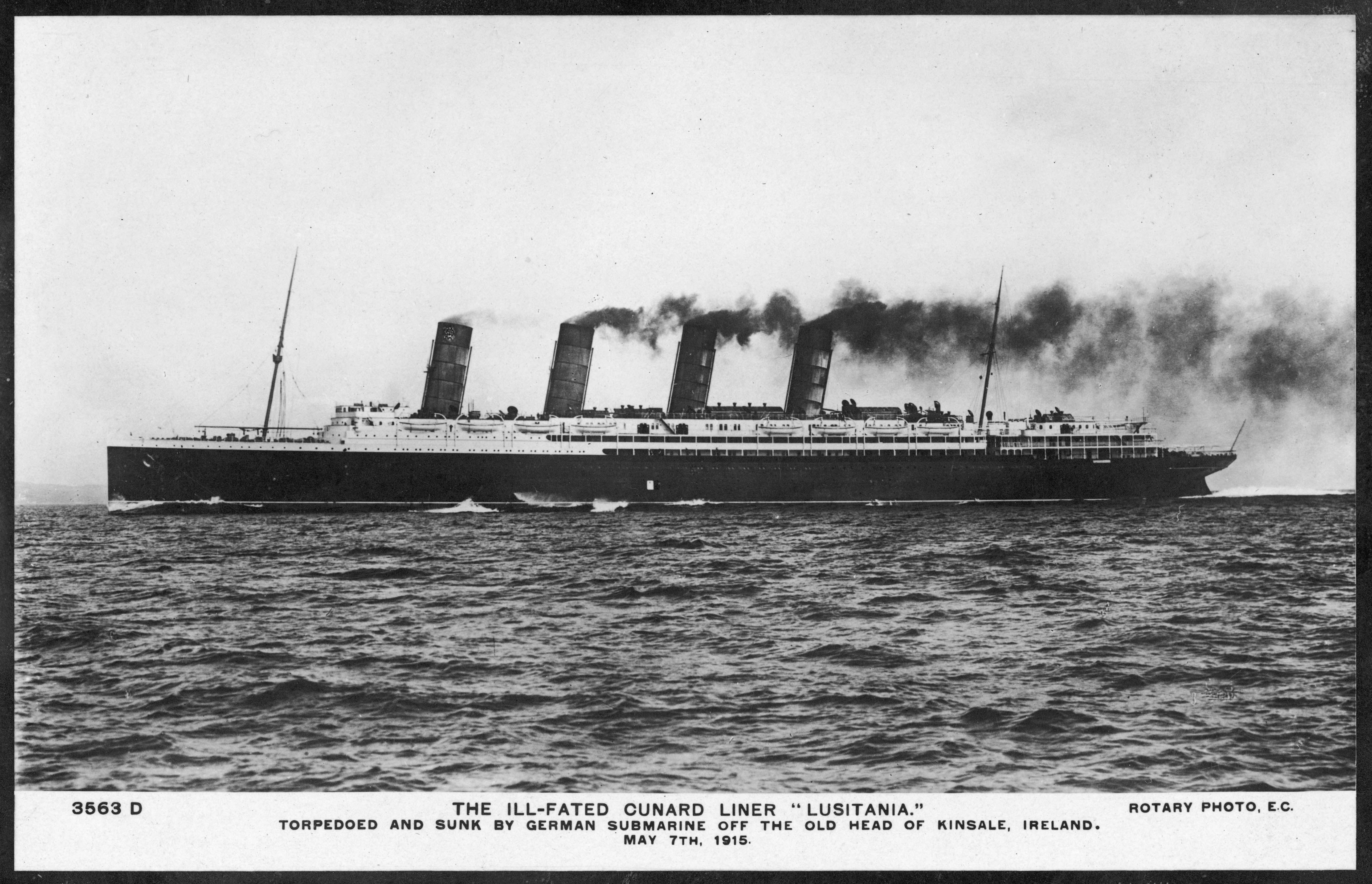
The RMS Lusitania, whose sinking on May 7, 1915 claimed the lives of nearly 1,200 passengers and crew, including 128 Americans.
Photo: Adobe Stock
April 16, 1916 — The Lafayette Escadrille is established. A French aviation unit largely made up of pilots from the United States. They, and those of the Lafayette Flying Corps, fly as combat pilots for France before the United States enters the war. Other Americans also fly in other Allied air services.
November 7, 1916 — President Wilson is reelected.
February 3, 1917 — United States severs diplomatic relations with Germany and President Wilson cites unrestricted submarine warfare as a threat to freedom of the seas.
March 1, 1917 — The United States is offered information concerning the Zimmermann Telegram suggesting Germany would support Mexico regaining American territory for joining an alliance against the United States.
April 2–6, 1917 — President Wilson demands, and the U.S. Senate approves a Declaration of War against Germany.
May 18, 1917 — The Selective Service Act is enacted to allow conscription of American men for military service.
May 26, 1917 — General John J. Pershing is appointed Commander in Chief of the American Expeditionary Force (A.E.F.).
June 13, 1917 — General Pershing lands in France.
June 25, 1917 — The first American units land in France. United States Army stevedores of a segregated African American unit disembark and begin to unload materiel and equipment. They are followed shortly by combat units of the First Expeditionary Division, later designated the 1st Infantry Division.
July 4, 1917 — The 16th United States Infantry parades in Paris and the grave of Revolutionary War hero the Marquis de Lafayette is honored by an American military delegation.
July 14, 1917 — Louis Ganella, the Medical Corps is the first serving American Soldier to be wounded by enemy action while with British forces near Arras.
September 4, 1917 — First AEF killed by the enemy. Four American soldiers are killed at work in an English military hospital at Dannes–Camiers by German night bombing.
September 5, 1917 — The 11th Engineer Regiment is the first American unit to suffer casualties in operations at the front from shelling near Gouzeaucourt.
November 2, 1917 — First American Soldiers killed in action. Three soldiers of the U.S. 1st Infantry Division are killed during a German trench raid on their position at Bathelemont.
November 7, 1917 — The Supreme War Council is established at Versailles as an organizing body unifying the efforts of the Allies. Initial military representatives include:
• General Ferdinand Foch, France
• General Tasker Bliss, United States
• Lieutenant General Sir Henry Wilson, Great Britain
• Lieutenant General Luigi Cadorna, Italy
November 30, 1917 — The first large American unit in direct combat with the enemy. The American 11th, 12th, and 14th Engineer Regiments work near Gouzeaucourt is interrupted by a German counter attack. Though unarmed they obtain weapons and join English troops fighting and digging in under fire.
December 17, 1917 — The United States Declares War on Austria-Hungary.
1918: Major U.S. combat operations and the war’s end
January 8, 1918 — President Wilson promulgates the “Fourteen Points” as a plan for a just peace.
March 3, 1918 — Russia declares a separate peace with Germany under the Treaty of Brest-Litovsk.
March 18, 1918 — The first report of Influenza at Camp Funston, a center of mobilization in Kansas. The pandemic will kill between 20 and 30 million people worldwide.
March 31, 1918 — In an effort to conserve food, fuel, and other materials, the United States enacts “Daylight Savings.” The nationwide one-hour adjustment of time is adopted by Canada the following month.
The Harlem Hellfighters
April 8, 1918 — The Harlem Hellfighters
The 369th Infantry Regiment, known as the Harlem Hellfighters, begins serving on the front lines alongside the French Army. Part of the 93rd Infantry Division, the regiment distinguished itself in combat and became one of the most celebrated African American units of the First World War. Other regiments of the division, including the 370th Black Devils and the 371st and 372nd Infantry Regiments, also served with distinction alongside French forces until the end of the war.
Read: The Harlem Hellfighters – World War I's Most Storied African American Combat Unit
The Harlem Hellfighters
Learn About African American Soldiers in WWI
April 9, 1918 — German forces attack along the Lys River, seizing Armentières, Mount Kemmel, and heights south of Ypres over the next two weeks. This causes a crisis in Allied command, but the front stabilizes. The American 16th Engineer Regiment, 1st Gas Regiment, and 28th Aero Squadron are committed to the defense.
May 27, 1918 — The German Army attacks along the Aisne River between Soissons and Rheims. The offensive reaches the Marne River before being halted by Allied resistance, including American forces at Château-Thierry and Belleau Wood.
May 28, 1918 — Battle of Cantigny
American troops of the 1st Infantry Division retake and hold the village of Cantigny against repeated German counterattacks. The battle marks the first major American offensive operation of the war and demonstrates the growing role of U.S. forces on the Western Front.
June 6, 1918 — Battle of Belleau Wood
American soldiers and Marines of the 2nd Infantry Division counterattack German forces at Belleau Wood with support from the French Army. Heavy fighting continues for two weeks across open fields and dense woodland. The battle becomes one of the most iconic engagements involving American forces during the First World War.
June 8, 1918 — The United States Navy begins laying the North Sea Mine Barrage, a vast anti-submarine minefield stretching between Scotland and Norway.
July 15, 1918 — Germany launches a major offensive from Château-Thierry to Rheims. American forces, including the 3rd Infantry Division, the 26th and 28th Divisions, and the 369th Infantry Regiment, help halt the advance. The 3rd Infantry Division earns the nickname “Rock of the Marne.”
July 18, 1918 — The Allied Aisne-Marne Campaign begins. French armies, reinforced by American divisions, launch a counteroffensive that pushes German forces back from the Marne and Aisne Rivers.
August 8, 1918 — British, French, American, Australian, and Canadian forces launch a major offensive on the Somme. The operation contributes significantly to the collapse of German defenses during the final months of the war.
August 10, 1918 — The United States First Army is established at La Ferté-sous-Jouarre, France. It includes the American I, IV, and V Corps, along with the French II Colonial Corps.
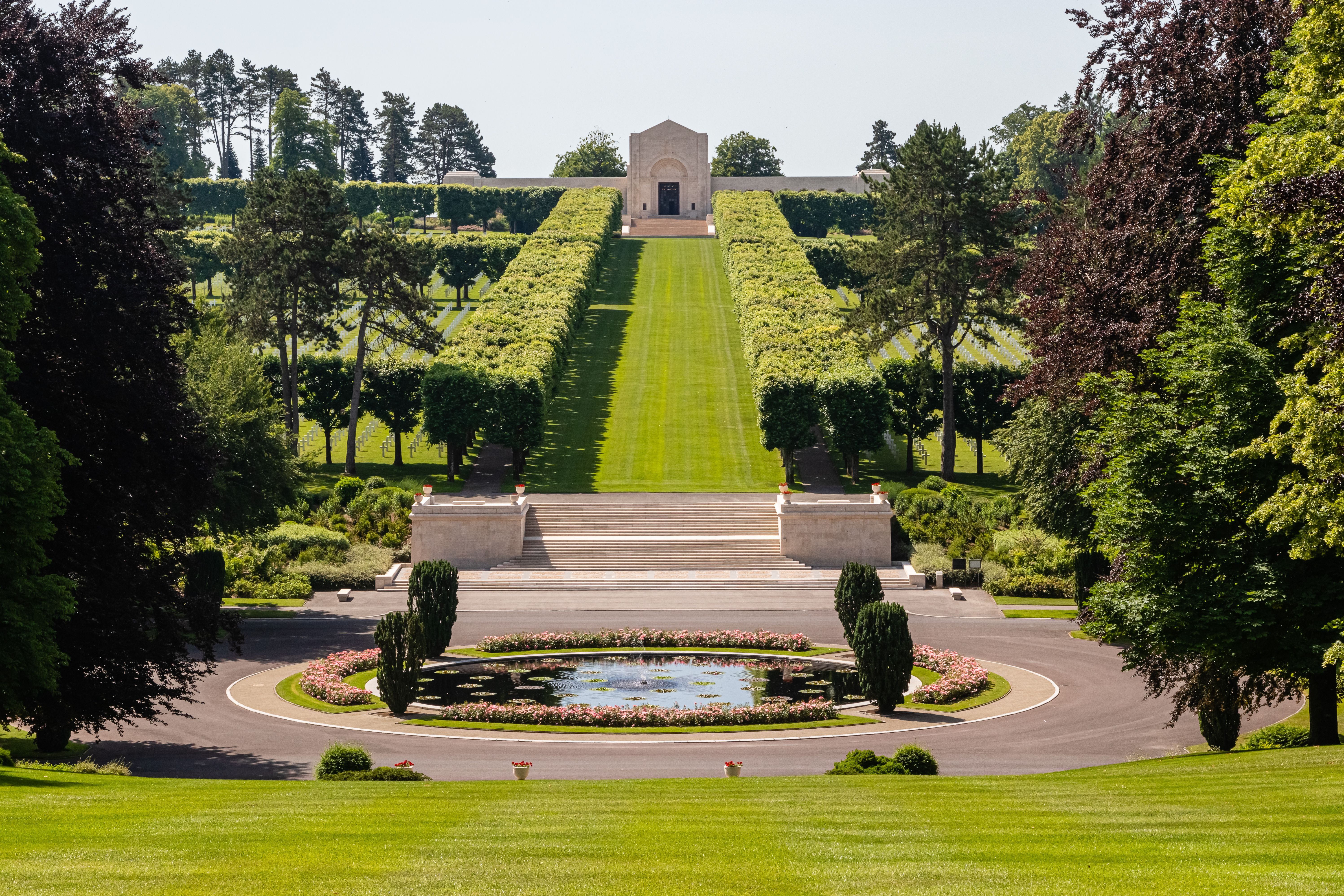
Meuse-Argonne American Cemetery, Romagne-sous-Montfaucon, France.
Photo © Philippe Paternolli / Adobe Stock
September 12, 1918 — St. Mihiel Offensive
The United States First Army launches the St. Mihiel Offensive, the first major American-led operation of the war. Supported by Allied forces, American troops push German forces back toward the Hindenburg Line. The offensive also marks the first use of tanks in combat by American forces and one of the earliest large-scale coordinated air operations under Brigadier General Billy Mitchell.
September 12, 1918 — Preparations begin for the Meuse-Argonne Offensive under the logistical direction of then-Colonel George C. Marshall. In just three weeks, the American Expeditionary Force repositions nearly one million men, along with supplies and equipment, to a new sector of the front.
September 23, 1918 — General Pershing praises the Services of Supply, headquartered in Tours, for providing the American Expeditionary Force with food, weapons, and matériel.
September 24, 1918 — The American 27th and 30th “Old Hickory” Divisions participate in the breaching of the heavily fortified Hindenburg Line between Bony and Bellicourt.
September 26, 1918 — The Meuse-Argonne Offensive begins. American and French forces launch one of the largest military operations of the war, advancing through successive German defensive positions with the support of tanks, aircraft, and artillery.
October 2, 1918 — The “Lost Battalion” becomes isolated near Charlevaux Mill. Surrounded by German forces, the unit holds its position for several days before being relieved by fellow soldiers of the 77th Infantry Division.
October 6, 1918 — The German Chancellor offers terms for an armistice. President Wilson rejects the initial proposal.
October 8, 1918 — Private Alvin York earns the Congressional Medal of Honor for extraordinary heroism during fighting in the Argonne Forest, where he captures more than one hundred German soldiers.
October 12, 1918 — The Second United States Army is created under General Robert Bullard as the American Expeditionary Force continues its advance.
November 1, 1918 — The Meuse-Argonne Offensive is renewed. American and French forces break through German defenses, accelerating the final collapse of German resistance.
November 6, 1918 — The American First Army advances toward Sedan, cutting a vital German supply route.
November 8, 1918 — German delegates arrive at Compiègne to receive Allied armistice terms.
November 9, 1918 — Kaiser Wilhelm II abdicates the German throne.
November 11, 1918 — Armistice Day
Fighting ceases following the signing of the Armistice at Compiègne. After more than four years of war, the guns fall silent on the Western Front, bringing an end to one of the deadliest conflicts in history.
December 1, 1918 — Allied troops move toward the Rhine to begin occupation duties.
December 14, 1918 — President Woodrow Wilson arrives in Paris to participate in the peace negotiations that will lead to the Treaty of Versailles.
1919: Peace negotiations and aftermath

January 4, 1919 — Peace Conference convenes in Paris.
June 28, 1919 — Germany, the United States, and the Allied Powers sign the Treaty of Versailles, the peace treaty that ends World War I.
July 9, 1919 — Germany ratifies the Treaty of Versailles.
July 10, 1919 — The United States Senate receives the Treaty of Versailles from President Wilson and begins to debate it.
July 14, 1919 — Americans join with other Allied armed forces in a great victory parade in Paris.
November 19, 1919 — The United States Senate rejects the Treaty of Versailles.
The First World War marked a defining chapter in the friendship between France and the United States. From the battlefields of France to the peace negotiations held in Paris and Versailles, the conflict strengthened ties between the two nations and shaped a shared history that endures today.
More than a century later, visitors can still discover this legacy across France — from Belleau Wood and Château-Thierry to the memorials of the Meuse-Argonne, the Palace of Versailles, and the streets of Paris where American troops once marched.

By Erika Elisabeth
Erika Elisabeth is Head of Marketing at Atout France USA