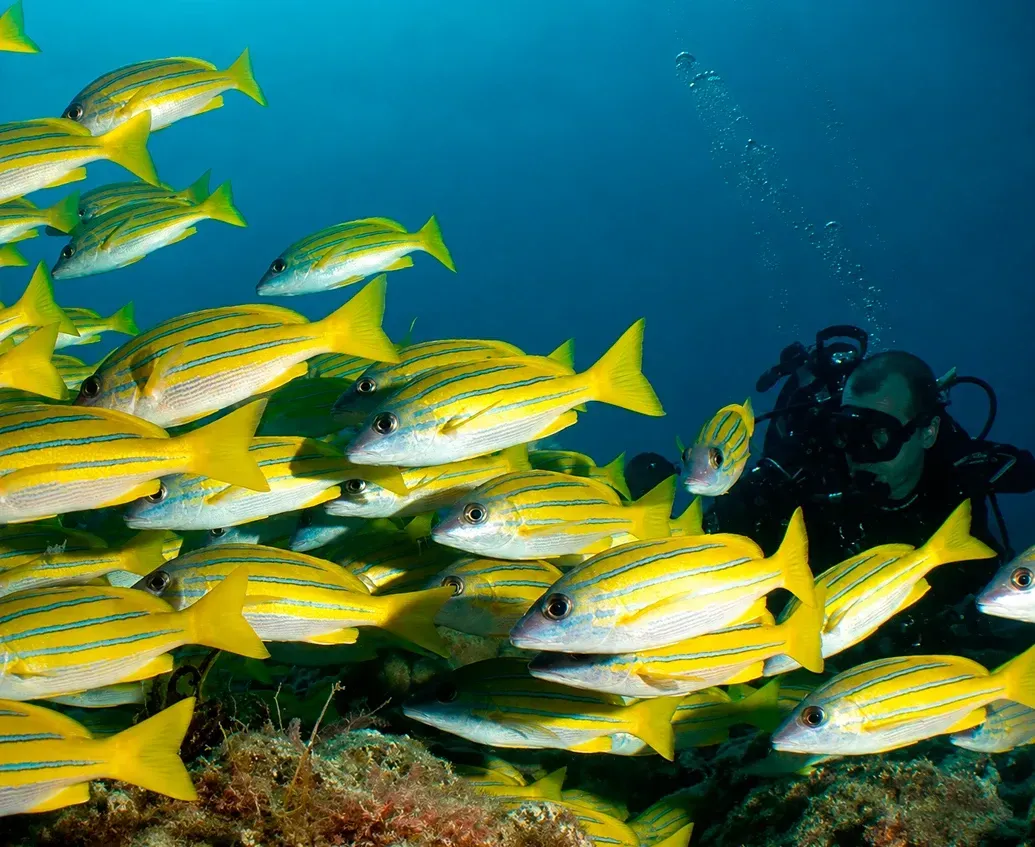
In 2023, New Caledonia celebrated the 15th anniversary of its lagoons being listed as a UNESCO World Heritage Site: 24,000 km² of teeming biodiversity, home to over 20,000 species living in waters with temperatures ranging from 21 to 28°C! Whether scuba diving, snorkelling or free diving, there’s something to suit all levels and tastes.
Walk under water at the Isle of Ducks

A 10 minute water-taxi ride from Nouméa, the marine reserve the Isle of Ducks is the ideal spot to get to know the lagoon life. From a depth of 2 to 7 meters, an underwater trail has been developed to educate young and old about the protection of the lagoon's biodiversity. Accessible to all, just don fins, facemask, and snorkel for a 30 minute exploration of the 400 meters of trail.
Dive into the heart of a shipwreck in Nouméa

The Dieppoise was the last wooden patroller of the French National Navy. Voluntarily sunk in 1988, the boat became one of the most famous shipwrecks of New Caledonia. It's also become an amazing artificial reef situated on the sand 26 meters below the water, close to the Amédée Lighthouse, a short distance from Nouméa
Swim with dwarf seahorses at Poindimié

Between the white sand beaches crowned with pine trees and the great reefs, the Tibarama Islet is the most popular of the 50 sites in Poinimié (on the coast of Grande Terre). Whether snorkeling, scuba diving or night diving, here you can admire the giant sea fans or catch a glimpse of the shy moray eels. At Bargibanti, the dwarf seahorse is the star of the show. You need a diving lamp to see them properly—they're only 2.4 centimeters long!
Worship at the Hienghène cathedral

Rich in flora and fauna, the sites of Hienghène on the east coast are above all known for their jaw-dropping reliefs. Between the sharp faults, tunnels, and sudden drops, the undersea cathedral is incredible, with vertiginous views and forests of coral. It's a spot reserved for experienced scuba divers
Unravel the mysteries of Prony's Needle

An enormous underwater chimney-like structure, measuring 15 meters in diameter, blasts hot water from deep underground. Only discovered in 1979, Prony's Needle produces a unique ecosystem by mixing hot freshwater from the earth's core with the ocean's seawater. In prime times of the year, divers can watch the humpback whales who return to the bay to mate every year.
Watch sea turtles and sharks in Lifou

A paradise of the depths, the Isle of Lifou is a beautiful window to underwater fauna and flora. Start with the “Gorgone Reef," an inimitable spot to the north of Santal Bay perfect for scuba diving. Turtles and leaf-fish, great white and leopard sharks glide between the archways of coral in the bay.
To find out more: Prepare your trip to New Caledonia

By Anne-Claire Delorme
Journaliste voyageuse. [email protected]