
In order to reduce CO₂ emissions in France's major cities, the most environmentally harmful vehicles are prohibited from driving in certain urban areas known as Low Emission Mobility Zones (ZFE-m). To circulate, vehicles not registered in France must (also) display a Crit'Air environmental sticker. Overview of the regulations in force following the repeal of the ZFE-m scheme voted in May 2025 by the lower house of the French parliament*.
Abolition of LEZs?
In May 2025, members of the parliament voted to abolish the Low Emission Zones (LEZs), also known as Zones à Faibles Émissions (ZFEs). However, the measure is not yet in force. It must still be approved by both houses of Parliament and validated by the Constitutional council. Until this legislative process is complete, LEZs and the associated traffic restrictions remain legally binding. If the abolition is confirmed, individual municipalities may still choose to retain LEZs through local decrees
What is the Crit'Air sticker?
The certificate is a round sticker that corresponds to a class of vehicle defined according to the emissions of atmospheric pollutants. There are 6 categories of certificates, each with a different colour, to encourage the least polluting vehicles. The Crit'Air sticker concerns all vehicles: private cars, two-wheelers, tricycles and quadricycles, light commercial vehicles and heavy vehicles including buses and coaches. Once acquired and affixed to the vehicle's windscreen, the sticker is valid for the entire life of the vehicle.
Traveling in France in an electric vehicle saves fuel and limits the carbon footprint of travelers. To facilitate the daily life of visitors, France.fr tells you where and how to find a recharging station for a serene and ecological vacation.

Which Crit'Air sticker is right for your vehicle (colour, criteria)?
Fuel type (petrol, diesel, electric, etc.), age of the vehicle, European emission standard (Euro standard) indicated on the registration certificate (car registration document)... the air quality certificate depends on several classification criteria:
- The Crit'Air 0 sticker (green and white) is for electric and hydrogen vehicles.
- The Crit'Air 1 sticker (purple) is for gas and rechargeable hybrid vehicles, petrol vehicles that meet Euro 5 and 6 standards (registered since 2011), and two-wheeled vehicles 4 and 5.
- The Crit'Air 2 sticker (yellow) applies to Euro 4 petrol vehicles (registered between 2006 and 2010), Euro 5 and 6 diesel vehicles and Euro 3 two-wheelers.
- The Crit'Air 3 sticker (orange) applies to petrol vehicles that meet the Euro 2 or Euro 3 standard (registered between 1996 and 2005), diesel vehicles that meet the Euro 4 standard, and two-wheeled vehicles that meet the Euro 2 standard.
- The Crit'Air 4 sticker (brown) applies to Euro 3 standard diesel vehicles and non-standard two-wheelers put into service between June 2000 and June 2004.
- The Crit'Air 5 sticker (grey) applies to Euro 2 standard diesel vehicles (registered between 1996 and 2000).
- Vehicles registered before 1997 are unclassified (Euro 1 standard).
Is the Crit'Air sticker mandatory?
The air quality certificate is mandatory for all vehicles wishing to drive in France, even occasionally, in certain urban areas known as Low Emission Mobility Zones. The Crit'Air sticker is also essential in the event that local authorities, such as prefects, implement differentiated traffic restrictions during pollution peaks.
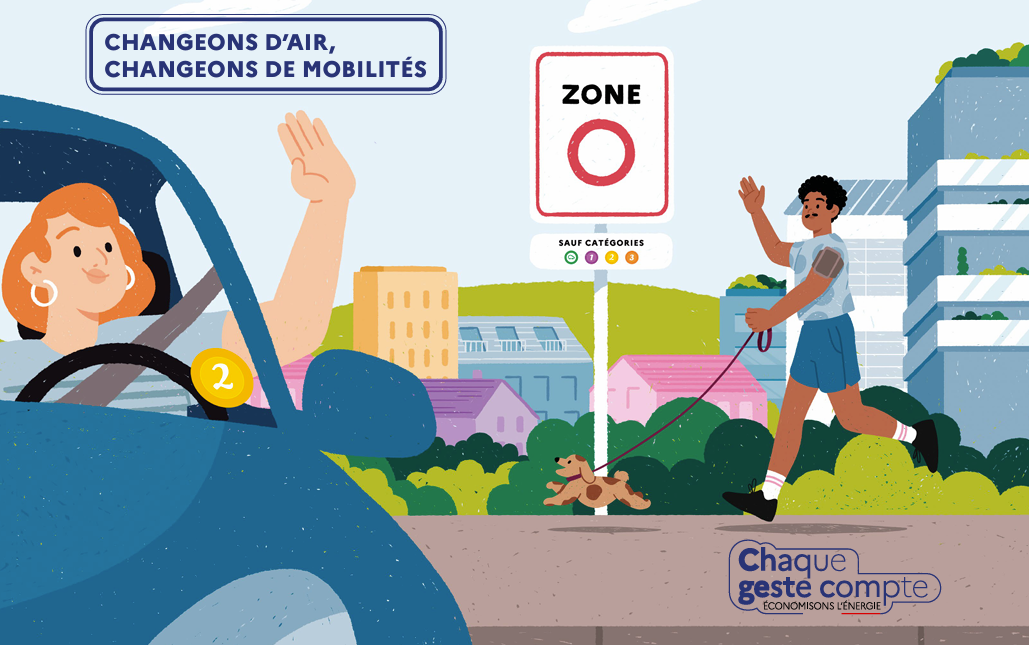
Which zones require a Crit'Air sticker?
The Crit'Air certificate is only compulsory in certain zones. In Paris, the sticker is compulsory within the perimeter of the A86 motorway from Monday to Friday, from 8am to 8pm, except on public holidays.
Several large cities have also set up low emission mobility zones. The agglomerations concerned are: Lyon, Aix-Marseille, Toulouse, Nice, Montpellier, Strasbourg, Grenoble, Rouen, Reims and Saint-Étienne. From 2025, all cities and agglomerations with more than 150,000 inhabitants will be required to introduce a Low Emission Mobility Zone. In these towns, ‘non-classified’ vehicles (registered before 1997) will no longer be allowed on the roads, except by special dispensation.
What are the regulations in force?
Since 1 January 2023, all Crit'Air 5 vehicles or vehicles without a sticker have been subject to traffic restrictions in Low Emission Zones. In some cities, Crit'Air 4 vehicles are also affected. Several cities also offer passes to allow occasional drivers to visit the city centre a limited number of times during the year.
Here is a summary of the measures in force in each of France's 11 Low Emission Zones:
- In Paris and Greater Paris, the ban on Crit'Air 3 cars is due to apply from 1 January 2025 (in addition to Crit'Air 4, 5 and non-classified vehicles already subject to restrictions). However, exemptions have been introduced. Vehicles with a Crit'Air 3 sticker will be able to drive in the EPZ at weekends. Occasional drivers will also be able to travel in Paris and the zone concerned up to 24 times a year if they have a ‘24-hour pass’.
- In Lyon and part of its metropolitan area, Crit'Air 3 private vehicles have also been affected by traffic restrictions since 1 January 2025. As in Paris, a ‘pass petit rouleur’ allows occasional drivers to drive in the EPZ 52 times a year.
The ban is due to apply to Crit'Air 3 cars from 1 January 2025. In addition, additional traffic restrictions may apply during pollution peaks. Traffic restrictions will only apply in urban areas where pollutant thresholds are exceeded. The following cities, known as "vigilance territories", are therefore no longer subject to these new restrictions (Crit'Air 3).
- In Montpellier, Crit'Air 3 vehicles will also be subject to these driving restrictions from 1 January 2025. As in Lyon, a ‘pass’ will guarantee motorists access to the communes in the Low Emission Zone 52 days a year. Drivers travelling less than 8,000 km in a year will also benefit from an exemption.
- In Grenoble, Crit'Air vehicles have been banned from driving in the Low Emission Zone since 7 July 2023. These restrictions will apply from 1 January 2024 for Crit'Air 4 cars and from 1 January 2025 for Crit'Air 4 cars, and are limited to certain hours (Monday to Friday, 7am to 7pm).
The new restrictions (Crit'Air 3) apply to petrol vehicles registered before 2006 and diesel vehicles registered before 2011.
- In Marseille, Crit'Air 4 cars are banned since 1 January 2024. Crit'Air 3 vehicles will no longer be allowed to circulate within the ZFE perimeter after 1 January 2025.
- In Strasbourg, Crit'Air 4, Crit'Air 5 and ‘unclassified’ vehicles are banned from driving within the ZFE-m perimeter. Traffic restrictions will not apply to Crit'Air 3 vehicles until 2027. A ‘ZFE 24h Pass’ allows occasional motorists to travel within the perimeter concerned 24 times a year.
- In Rouen, all vehicles displaying a Crit'Air 4, 5 or non-classified sticker have been banned from driving since 1 September 2022. However, a ‘ZFE-m 24h’ pass allows you to travel in the area concerned 24 times a year. The ban due to apply to Crit'Air 3 cars in 2025 has been suspended.
- In Toulouse, all Crit'Air 4, 5 and non-classified vehicles have been affected by the driving restrictions since 1 January 2023. However, a ‘Pass ZFE’ allows access to the area concerned 52 days a year. Crit'Air 3 cars can continue to drive.
- In Reims, the driving ban has applied to Crit'Air 5 and Crit'Air 4 vehicles since 1 January 2023. The restrictions will not apply to Crit'Air 3 vehicles until 2029.
- In Nice, Crit'Air 5 and non-classified passenger cars have been affected by the restrictions since 1 January 2023. However, Crit'Air 4 and Crit'Air 3 vehicles can continue to drive.
- In Saint-Etienne, light vehicles are not affected by the restrictions.
- In Clermont-Ferrand, private cars are not affected by the restrictions.
How do I get a Crit'Air sticker?
French or foreign motorists can order the sticker online on the website of the Ministry of Ecological and Solidarity Transition (the only official site authorised to issue them, beware of scams! ): https://certificat-air.gouv.fr The cost is 3.70€ plus postage (3,11€ + 1,50€). The estimated delivery time is 5 to 10 days. Please note that offending vehicles will be fined 68€ for a private car and 135€ for a coach.
More information on the official website of the Crit'Air certificate: https://www.ecologique-solidaire.gouv.fr/certificats-qualite-lair-critair (available in English, German, Italian, Spanish).
Tips and recommendations
To make it easier to get around during your stay in France, including in cities and urban areas subject to traffic restrictions, opt for sustainable modes of transport such as public transport (bus, metro, tram), cycling or walking. Carpooling is also an alternative solution for sharing your journey with other travellers or users.
To find out your travel time and simulate your route based on your vehicle class and current regulations, consider consulting the Itineriz platform set up by the government.

By France.fr
The magazine of the destination unravels an unexpected France that revisits tradition and cultivates creativity. A France far beyond what you can imagine…


